
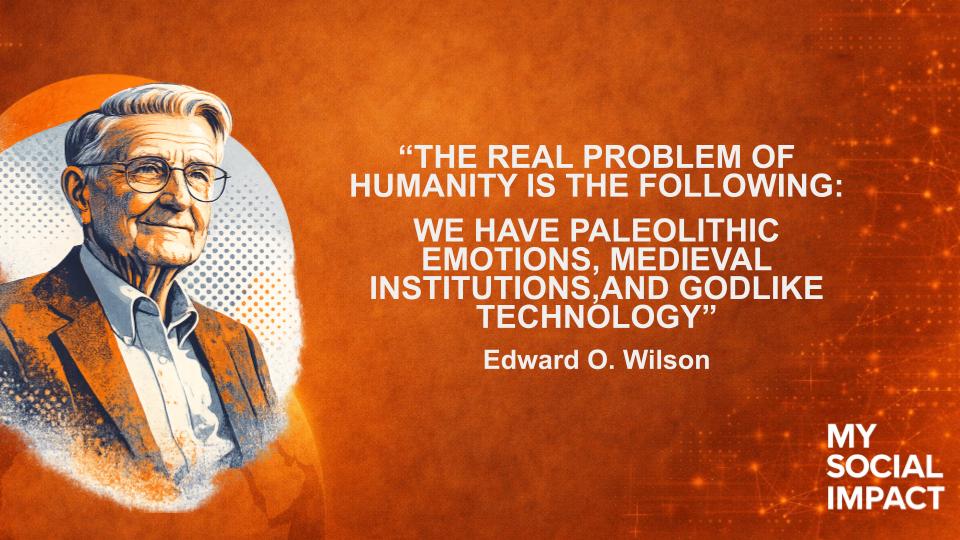
I think the brilliant quote above is basically saying that we’re still cavemen and women, but now we’re dwelling in a world where technology has reached bewildering proportions… we’re biologically evolved to hunt monkeys, yet somehow managed to create something more intelligent than ourselves (which is a little alarming isn’t it?) The “medieval institutions” around us have been slow to adapt… However, this represents a huge opportunity for those ready to embrace it.
Early humans managed to create fire about a million years ago, perhaps now we can harness the power of technology and data, to start actually solving the massive societal and environmental problems of our day?
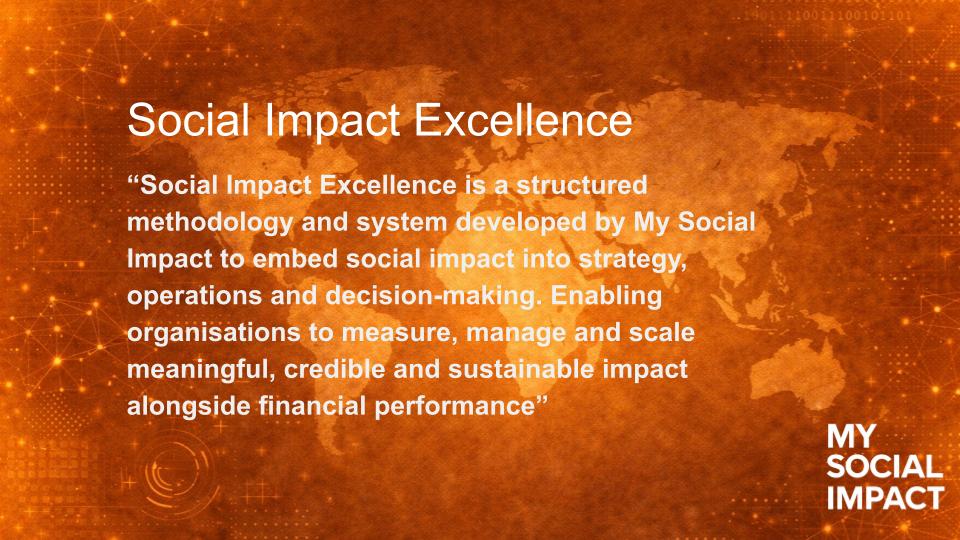
Whilst part of me is still temped to revert to the life of our cave dwelling ancestors, I also feel compelled to try and do my bit, and so I’ve written a presentation called “Social Impact Excellence“. The slide below, from the presentation itself explains what this actually is:
If you’d like me to present this to you (and your team perhaps), and have a chat afterwards, then please email me at marcus@mysocialimpact.org and we can arrange a time for a call. Takes about 15 minutes to present.
Social impact is becoming more important to organisations of every kind. What is changing now is the level of expectation. It is no longer enough to say that an organisation is doing good. Increasingly, organisations are expected to show what change they are creating, how they know it, and whether that change is meaningful, credible and capable of growing over time.
That is the thinking behind Social Impact Excellence.
At My Social Impact, we’ve developed an approach to help organisations define, embed, measure and communicate social impact with greater rigour. Our vision is simple: a world where social impact is taken as seriously as financial performance.
Email marcus@mysocialimpact.org if you’d like to see the full presentation
It’s a disarmingly simple idea (I’m still basically a caveman): Social impact should be treated as a management discipline, not just a reporting requirement. It should be embedded into strategy, leadership, operations, data and communication, rather than sitting off to one side as a narrative layer or annual exercise.
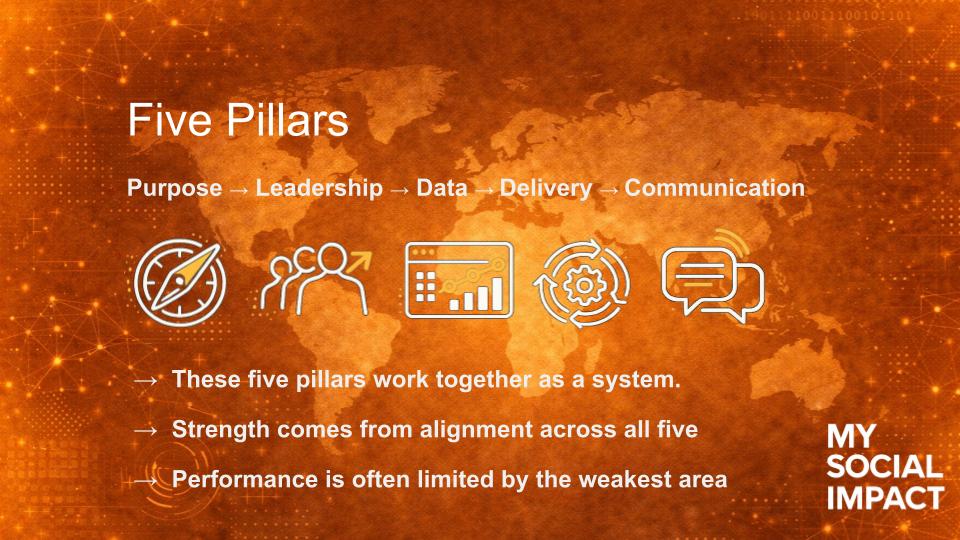
In practice, embedding Social Impact Excellence comes down to five key pillars: purpose, leadership, data, delivery and communication. These are the core components of how impact is actually created, managed and scaled.
Email marcus@mysocialimpact.org if you’d like to see the full presentation
Why this matters now
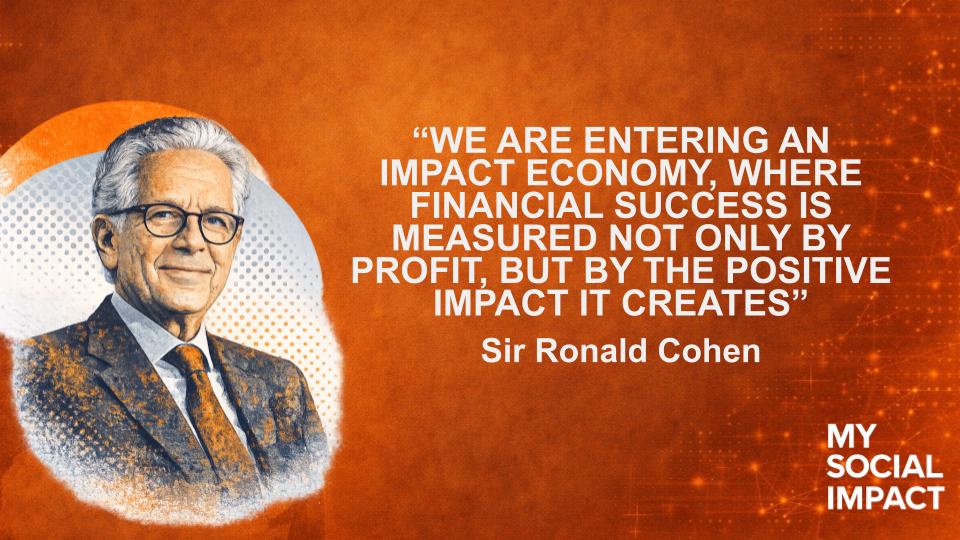
The shift towards social impact is part of a much bigger change in how capital flows, how economies are understood, and how organisations operate.
I studied Industrial Economics at the University of Nottingham more than twenty-five years ago. Even then, the dominant thinking was still centred on profit maximisation. Stakeholder economics existed, but it felt secondary. This has now shifted considerably already.
For centuries, economic thinking has been dominated by profit maximisation, shareholder primacy and an obsession with GDP growth. Profit and growth still matter, but they are no longer enough on their own. A wider shift is underway towards a more “Human Economics”, one that asks not only how much value is created, but for whom, at what cost, and whether it is sustainable.
This shift is being driven by customers, staff, founders, investors and policymakers alike. Social impact now sits at the centre of that conversation.
In the presentation, I describe this as three connected shifts: the capital shift, the macroeconomic shift, and the organisational shift.
The Capital Shift
The impact economy is already significant and growing fast.
The Global Impact Investing Network (GIIN) estimates the market at over $1.5 trillion, growing at around 20% annually. At the same time, 90% of investors say that impact measurement imporves decisions.
Capital is moving towards organisations that can demonstrate impact, not just talk about it. This is where many organisations are exposed. Not because they are not doing good work, but because they cannot evidence it clearly enough.
We are moving from philanthropy to proof, from grants to growth, and from activity to measurable outcomes and impact.
The Macro-Economic Shift
Alongside this, the definition of economic value is changing.
Over $130 trillion of capital is aligned to responsible investment principles (UN PRI), and institutions are increasingly looking beyond GDP towards wellbeing, sustainability and quality of life (OECD, LSE)
The conversation has shifted from shareholder primacy towards stakeholder value (WEF, Business Roundtable).
Organisations are no longer judged purely on financial performance, but on how they create value more broadly, for people, communities and the environment.
The Organisational Shift
These changes are now playing out inside organisations themselves.
95%+ of large companies report on ESG, but usefulness remains limited (KPMG). At the same time, there are now over 10,000 B Corps globally, embedding impact more directly into their business models.
Alongside this, a growing ecosystem of organisations and frameworks is shaping how impact is measured and managed. Institutions such as the Global Impact Investing Network (GIIN) and the International Finance Corporation (IFC), alongside frameworks like IRIS+, the Impact Management Project (IMP) and the UN Sustainable Development Goals (SDGs), are helping to bring more structure, consistency and comparability to impact data.
Investors are responding to this. Expectations are rising, and the questions are becoming more rigorous. But there is still a gap.
Many organisations are good at talking about impact, fewer are good at measuring it, and fewer still are managing it as part of how the organisation actually operates. That is the real shift:
From reporting impact to managing and delivering real, sustainable impact
A personal perspective: finance meets impact
Social impact consulting is still a relatively new field. That is part of what makes it exciting. But the underlying logic is not new at all.
Accounting has spent centuries developing ways to track and interpret performance. Management consulting has long focused on strategy, operations and transformation. IT consulting has helped organisations design systems, structure data and support decision-making at scale.
The opportunity now is to bring these disciplines together into the world of social impact.
As a Chartered Accountant, I find this particularly compelling. In finance, there is an expectation that performance is defined, measured and explained. Social impact, in many cases, is not yet at that level.
In many organisations, the work itself is strong, but the way it is defined, measured and evidenced is not yet at the level required for serious scale, funding or investment. That creates a ceiling. Not on intent, but on growth.
Setting the frame: Language and definitions
You may already be familiar with Theory of Change. I find it one of the most useful ways to think clearly about impact.
In practice, many organisations stop too early. Some focus on inputs, activities or outputs. More mature organisations reach outcomes. But social impact sits beyond outcomes. It is the broader, deeper and more lasting change that flows from them over time.
At My Social Impact, we also talk about social impact legacy. This goes a step further. It asks whether the impact being created is capable of enduring beyond the organisation itself, or even beyond the founder.
That is a powerful shift in thinking. It moves the conversation from short-term activity to long-term, sustainable change.
The gap between intention and reality
Working between the UK and East Africa, I have seen a wide range of organisations doing genuinely valuable work.
But there is often a gap. Many organisations are strong on intent and activity, but weaker on structure, evidence and communication. Impact is often described through stories and examples, but not always through clear logic or robust data.
In a world where expectations are rising, that gap becomes a constraint. It affects credibility, funding and ultimately the ability to scale.
The five pillars in practice
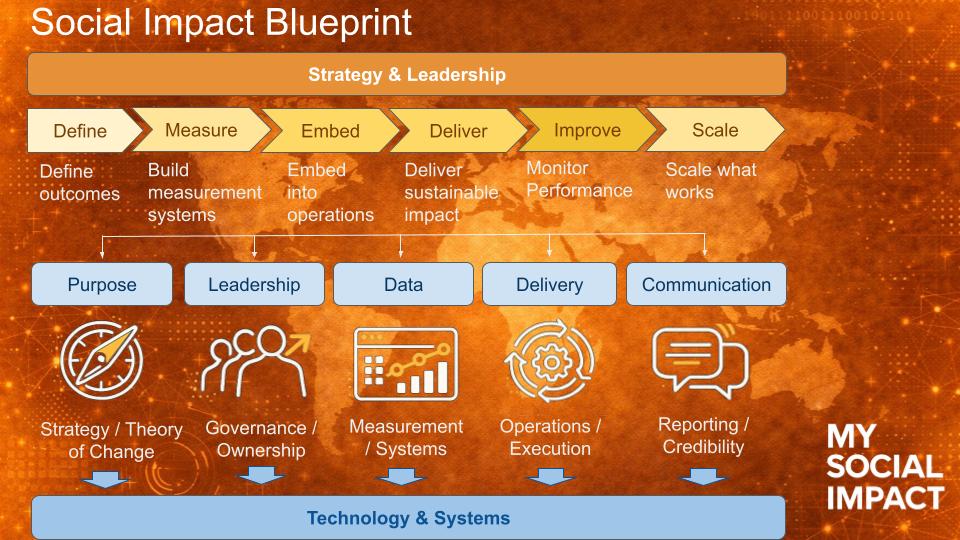
At the centre of Social Impact Excellence are five core pillars: purpose, leadership, data, delivery and communication.
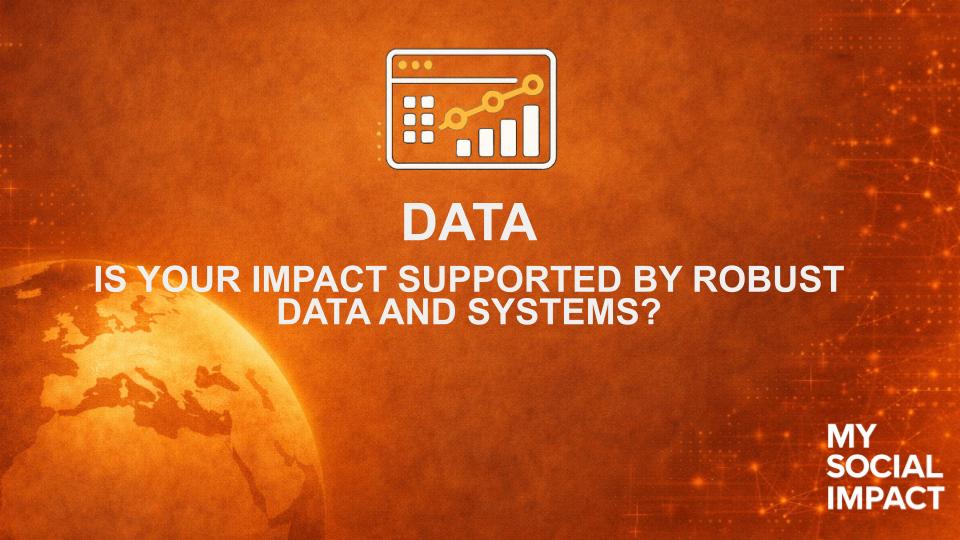
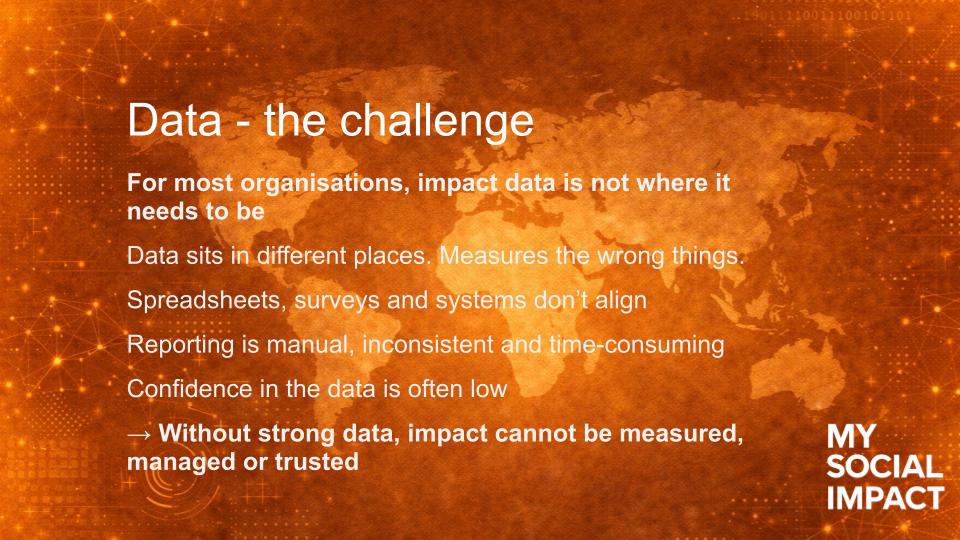
Purpose defines the change you are trying to create and ensures it is meaningful and clearly articulated. Leadership ensures that this is owned and prioritised at the highest level. Data provides the systems and evidence needed to understand what is happening and to inform decisions. Delivery is where impact is actually created in practice, through operations and business models. Communication ensures that it is conveyed in a way that is engaging, credible and trusted.
In practice, every meaningful improvement in impact performance can be traced back to progress in one or more of these five areas. Equally, most challenges can be traced back to weakness in one of them. That is why they sit at the centre of everything we do.
Email marcus@mysocialimpact.org if you’d like to see the full presentation
Understanding where you are: the Social Impact Maturity Assessment
Most organisations are tempted to jump straight to solutions. A report, a framework, a dashboard or better messaging. But without understanding the foundations, those solutions often miss the mark or fail to stick. That is why we start with maturity.
The Social Impact Maturity Assessment provides a structured way to evaluate performance across the five pillars. It examines purpose, leadership, data, delivery and communication in a consistent and practical way.
It asks simple but important questions. How clearly is impact defined? Who owns it? What systems are in place? What evidence exists? Where are the gaps?
The result is not just a score, but a clearer understanding of reality.
From maturity to clarity: deeper diagnostic
For many organisations, that initial assessment is just the starting point.
A deeper diagnostic allows for a more thorough review of systems, data and processes, helping to move from surface-level insight to a grounded understanding of what is actually happening in practice.
This is often where the most valuable insights emerge. Assumptions are challenged, inconsistencies are identified and priorities become clearer.
Designing the future: the Social Impact Blueprint
The Social Impact Blueprint defines how impact should work across the organisation in practice. It is not just a conceptual model, but a structured design that sets out how each of the five pillars should operate, how they connect and what needs to change.
Typically developed through a combination of workshops, analysis and practical review, the output is a clear and usable framework tailored to the organisation. One that leadership can align around, teams can work from and that provides a foundation for measurement, reporting and decision-making.
Without this step, implementation tends to become fragmented.
Email marcus@mysocialimpact.org if you’d like to see the full presentation
Turning design into action: the roadmap
The Roadmap to Excellence translates that blueprint into a practical plan. It sets out what needs to be done, in what order and over what timeframe, recognising that not everything can or should be done at once.
It identifies priorities, quick wins and longer-term structural changes, helping organisations move forward in a way that is both realistic and strategic.
This is where progress becomes tangible. Where impact moves from something that is discussed to something that is actively managed and improved.
Storytelling and evidence
“The brands that will thrive in the coming years are the ones that have a purpose beyond profit.”
— Richard Branson
Storytelling remains essential. It brings impact to life and connects organisations with people.
But storytelling on its own is no longer enough. It needs to be supported by evidence.
The strongest organisations combine both.
Why this is an opportunity
This shift creates both pressure and opportunity.
Organisations that can demonstrate impact clearly are better positioned to attract funding, build trust and scale. In regions such as East Africa, where challenges are significant but so is entrepreneurial energy, this becomes particularly powerful.
What are often described purely as problems can also be seen as opportunities for better systems, better investment and more meaningful impact.
A final thought
Social impact is no longer a side story. It is becoming central to how organisations define success, build trust and grow.
The organisations that move early will not only be better positioned to attract funding, talent and partnerships. They will help define what good looks like in this space.
The question is no longer whether impact matters. It is whether you can define it clearly, measure it credibly and use it to drive better decisions.
We now have the tools. The opportunity is here.
The question is whether organisations are ready to use them.
Marcus Warry
Founder and Director, My Social Impact
Marcus works between the UK and East Africa, increasingly acting as a bridge between the two. His work spans both consulting and hands-on delivery: supporting organisations with social impact strategy, measurement, reporting and systems, while also helping build and deliver impact-oriented projects on the ground in East Africa. He is currently researching the 75 B Corps operating in Uganda, with plans to expand that work across East Africa, and is also launching the B Corp and Social Impact Club to bring together like-minded people and organisations committed to creating meaningful impact in the region.