
SOCIAL IMPACT MATURITY ASSESSMENT
The Social Impact Maturity Assessment is designed for social enterprises, B Corps, corporates and brands that are seeking to balance commercial performance with credible, measurable social impact.

We are also developing a dedicated Social Impact Maturity Assessment for charities and NGOs. More information is shared below.
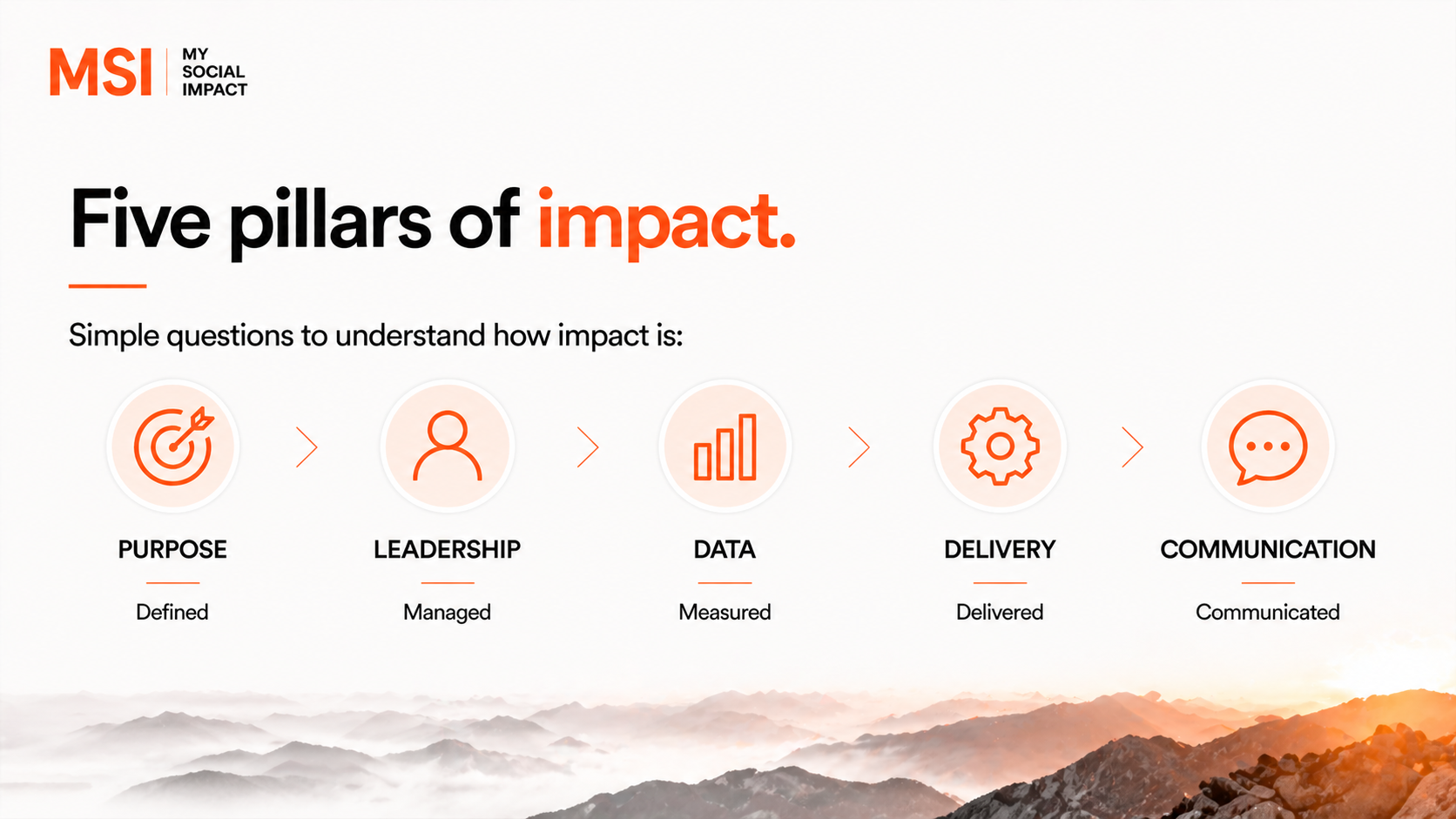
The Social Impact Maturity Assessment examines how mature an organisation’s approach to social impact is across five pillars:
1. Purpose – defines your intent
2. Leadership – governs it
3. Data – proves it
4. Delivery – executes it
5. Communication – explains it
Each of these 5 pillars must work together.
If one is weak, the overall effectiveness and credibility of your impact is reduced.
This is not a compliance or ESG-led exercise. We treat impact as a management issue, not just a reporting requirement.
Where many impact offers lead with frameworks, standards and disclosures, this assessment starts with intent, capability, evidence and commercial reality, because without those, reporting has little meaning.
ACCESSING THE ASSESSMENT
To request access to the Social Impact Maturity Assessment, please email:
marcus@mysocialimpact.org
Access to the assessment includes a 30-minute follow-up call to discuss the results, gaps and opportunities to move towards “Social Impact Excellence’.
WHAT THE ASSESSMENT LOOKS AT
The assessment explores how mature an organisation’s approach to social impact is across five core pillars. It is designed to surface the gap between intent, capability, evidence and commercial reality, and to provide the basis for a structured foundation for improvement.
PILLAR 1 – PURPOSE
Social Purpose, Impact Strategy and Theory of Change
Why this pillar exists
Many organisations state a social purpose but struggle to clearly define the change they are trying to create, or how their activities lead to meaningful outcomes.
What it probes for
Clarity and focus of social purpose, the existence of a deliberate impact strategy, and whether there is a coherent logic linking activities to outcomes and impact.
Early, light-touch alignment to globally recognised frameworks such as the SDGs may be considered as a sense check, without those frameworks driving strategy.
What it is designed to make the organisation think about
Have we clearly defined the impact we are trying to create, or are we relying on broad intentions and assumptions?
Pillar 2 – LEADERSHIP
Impact Leadership, Team and Capability
Why this pillar exists
Social impact is often under-owned and under-resourced relative to its stated importance.
What it probes for
Where responsibility for impact sits, how senior that ownership is, how joined-up impact activity is across teams, and whether there is sufficient capability and capacity to manage impact effectively.
What it is designed to make the organisation think about
Have we resourced social impact in line with how important we say it is?
Pillar 3 – DATA
Impact Data, Systems and Technology
Why this pillar exists
Strong ambition without strong data leads to weak evidence, limited learning and poor decision-making.
What it probes for
The quality and consistency of impact data, the systems and tools in use, the ability to establish baselines and track change over time, and whether data is used to inform management decisions rather than just reporting.
What it is designed to make the organisation think about
Could we evidence our impact credibly and show improvement over time, or are we mainly describing activity?
Pillar 4 – DELIVERY
Impact Delivery, Economics and Sustainability
Why this pillar exists
Impact that is not operationally and economically viable is rarely sustainable.
What it probes for
How impact is delivered in practice, whether it is embedded in core business operations or delivered alongside them, how it is funded, and how well the organisation understands the costs and value associated with delivering impact.
This includes consideration of:
- ROI — commercial value created or protected (e.g. revenue, cost savings, risk reduction)
- SROI — an understanding of the social value created relative to investment
What it is designed to make the organisation think about
Does our impact exist because of how the business operates, does it make economic sense, and would it continue without ideal funding conditions?
Pillar 5 – COMMUNICATION
Social Impact Marketing, Communitation and Reporting
Why this pillar exists
Even well-delivered impact can lose credibility if it is poorly communicated or weakly reported.
What it probes for
How impact information is used internally, how it is communicated externally, whether narratives are grounded in evidence, and whether the organisation can produce a clear and credible social impact report.
Formal mapping to globally recognised frameworks such as the SDGs may be used here as a communication and translation tool, based on real outcomes and data.
What it is designed to make the organisation think about
Could we confidently explain and report our impact in a way that others would understand and trust?
OVERALL INTENT OF THE ASSESSMENT
The Social Impact Maturity Assessment is designed to help organisations reflect on whether their approach to impact is:
- Intentional rather than assumed
- Operational rather than aspirational
- Evidence-led rather than anecdotal
- Economically viable as well as socially valuable
It provides a structured foundation for improving how impact is defined, delivered, measured and reported.
WHAT HAPPENS AFTER THE ASSESSMENT
Once the assessment is complete, we’ll schedule a 30-minute call to talk through the results.
This discussion is designed to:
- clarify your maturity profile across the five pillars
- highlight key strengths, gaps and risks
- identify practical priorities for improvement
- sense-check next steps in light of your organisational and commercial context
To request access to the assessment, email:
marcus@mysocialimpact.org
FOR CHARITIES AND NGOs
We are developing a dedicated Social Impact Maturity Assessment for charities and NGOs, designed around non-profit and grant-funded operating models.
As the development landscape continues to change, governments, DFIs and large institutional funders are placing increasing emphasis on evidence, outcomes and accountability. With trillions now flowing through the broader impact economy, the ability to credibly define, measure and communicate impact is becoming critical to securing and sustaining funding.
If you represent a charity or NGO and would like to enquire about this assessment, please contact me at
marcus@mysocialimpact.org