“Every child is an artist. The problem is how to remain an artist once we grow up.”
Pablo Picasso
Hardly a day goes by without another headline claiming artificial intelligence is about to transform the way we work.
I believe it will.
But after spending the past few months working alongside AI almost every day, I think we’ve been asking the wrong question.
Most of the conversation has focused on what AI can do.
The more interesting question is what humans should do.
Because the better artificial intelligence becomes, the more valuable human intelligence becomes.
Not intelligence measured by qualifications or technical expertise.
I’m talking about judgement.
Perspective.
Curiosity.
Creativity.
Relationships.
Commercial awareness.
The confidence to challenge assumptions.
The ability to ask better questions.
This article isn’t really about AI.
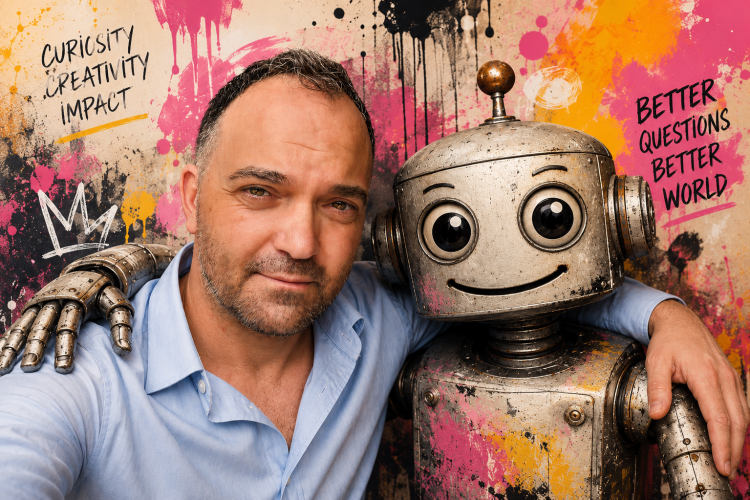
It’s about what happens when artificial intelligence and human intelligence work together.
Because that’s where I believe the real opportunity lies.
I’ve spent hundreds of hours talking to AI
Over the past few months I’ve probably spent hundreds of hours working with AI.
Some of that time has been helping shape ideas.
Some has been writing.
Some has been analysing information.
Some has been for relationship advice or the occasional pep talk 🤣
More recently, it’s been helping me build the beta version of a new platform for My Social Impact that will help organisations assess and strengthen their social impact.
It has been one of the most fascinating learning experiences of my career.
Not because I’ve learnt how AI writes code.
Because I’ve learnt how people think.
Or perhaps more accurately, how often we don’t think clearly enough.
One evening I’d burnt through a large number of AI credits trying to improve a customer relationship management system I was building.
By the end of the evening, the software looked impressive.
The following morning I opened it and realised I’d spent hours solving the wrong problem.
The AI hadn’t made the mistake.
I had.
That was a humbling lesson.
AI isn’t just changing technology.
It’s exposing the quality of our thinking.
I’ve seen this before
In many ways, AI reminds me of another technology that transformed my profession.
Back in 2012, I founded an accounting practice called Archie & Doris, just as Xero was beginning to revolutionise cloud accounting.
I loved it.
For the first time, business owners could understand their finances without needing to decipher complex accounting software.
I genuinely encouraged clients to embrace it.
In fact, I sometimes joked that if they learnt Xero properly, they might not need accountants like me anymore.
Then something interesting happened.
They did use it.
Many became far more confident.
But they still picked up the phone.
Not because Xero wasn’t good enough.
Because software doesn’t remove uncertainty.
It changes where uncertainty exists.
Clients no longer needed someone to process every transaction.
They needed someone to help interpret what the numbers meant.
To ask better questions.
To challenge assumptions.
To make better decisions.
Fourteen years later, I think AI is creating exactly the same shift across almost every profession.
A remarkable opportunity
One of the most exciting things about AI isn’t that it can write emails or summarise meetings.
It’s that it has dramatically lowered the barrier to creating bespoke software.
Until recently, building your own systems was largely the preserve of large organisations with sizeable development budgets.
Today, a small charity, a social enterprise, a growing consultancy or an ambitious founder can create surprisingly capable internal tools using everyday language.
That changes everything.
Especially for small and medium-sized organisations.
Ironically, they’re often better placed than larger organisations.
Many larger organisations are constrained by legacy systems, procurement processes and years of technical debt.
Smaller organisations can often move faster because they’re starting with a blank sheet of paper.
But there is a trap
Just because almost anyone can build software doesn’t mean almost anyone will build something useful.
I’ve discovered that the difficult part isn’t asking AI to build.
It’s deciding what to build.
AI will happily generate ten different solutions before you’ve properly defined the problem.
It never complains.
It never gets tired.
It simply keeps building.
Which means responsibility shifts back to us.
Clarity has become more valuable than coding.
A process before a prompt
One thing I’ve learnt is that AI rewards good thinking.
Through plenty of trial and error, I’ve gradually settled on a simple process before asking AI to build anything.
Start with the real problem.
Define the minimum useful version.
Separate today’s priorities from tomorrow’s ambitions.
Agree the overall architecture before writing a single line of code.
Build in manageable stages.
Review every stage before moving on.
Then repeat.
None of those steps involve artificial intelligence.
Every one of them depends on human intelligence.
That’s why I believe organisations that combine both will outperform those relying on either alone.
“Artificial intelligence can help us create faster. Human creativity ensures we create something worth remembering.”
Dr Chris Arnold
Co-founder, My Social Impact | Former Board Creative Director, Saatchi & Saatchi
Ideas are easy. Turning them into action is harder.
One of the reasons we created The Ideas Shed was because we kept seeing good ideas fail long before they became reality.
The Ideas Shed sits alongside My Social Impact and Good Numbers as part of a wider ecosystem designed to help organisations become stronger in different ways.
My Social Impact focuses on social impact strategy, leadership, data, delivery and communication.
Good Numbers helps organisations become more financially resilient through better financial information and practical support.
The Ideas Shed focuses on strategy, creativity, innovation, marketing, business development and AI implementation.
Its purpose is simple.
To help organisations turn ideas into action.
Increasingly, that means helping organisations understand where AI genuinely adds value, develop practical solutions and improve operations without losing sight of the people they’re trying to serve.
The three businesses are connected by one simple belief.
Better numbers. Clearer ideas. Stronger impact.
Should you do it yourself?
Absolutely.
That might sound like an odd thing for a consultant to say, but I genuinely believe it.
Open ChatGPT.
Experiment.
Build something.
Break something.
Start again.
You’ll learn more in an afternoon of experimentation than you will from weeks of reading articles about AI.
But don’t be surprised if you eventually discover what many Xero users discovered over a decade ago.
Brilliant technology doesn’t eliminate the value of experience.
It changes where experience adds value.
Sometimes a light-touch conversation with somebody who’s already made the mistakes can save weeks of frustration and unnecessary iteration.
Not because they know more about AI.
Because they’ve become better at asking the questions that AI can’t ask for you.
The conversation I’d rather have
I’ve recently started offering informal founder-to-founder conversations.
Sometimes we spend half an hour talking about AI.
Sometimes we don’t mention AI at all.
Instead we talk about growth.
Purpose.
People.
Marketing.
Social impact.
Or simply the challenge of turning a good idea into something that actually works.
The technology is rarely the most interesting part.
The thinking usually is.
So here’s my challenge.
Spend thirty minutes talking to ChatGPT.
Then spend thirty minutes talking to another founder who’s built organisations, made mistakes and learnt a few lessons along the way.
At the end, ask yourself which conversation helped you think differently.
You might discover the answer isn’t either/or.
It’s both.
Because artificial intelligence doesn’t replace human intelligence.
It amplifies it.
AI builds faster. Humans decide what is worth building.
Email me here: marcus@mysocialimpact.org to arrange a 30 minute call – let’s see if 30 minutes with my human pea brain adds any value to you?
A final thought
This issue reflects a much broader challenge than technology.
Whether we’re talking about AI, leadership or social impact, organisations succeed when they combine good ideas with disciplined execution.
At My Social Impact, we help organisations strengthen five core pillars:
Purpose. Leadership. Data. Delivery. Communication.
Because real impact is not just about intention.
It is about how well it is designed, delivered and measured.
If you’d like to explore how AI could support your organisation, or simply have a founder-to-founder conversation about ideas, innovation or social impact, I’d be delighted to chat.
My Social Impact
https://mysocialimpact.org
Good Numbers
https://www.goodnumbers.uk
The Ideas Shed
https://www.theideasshed.com
Email
marcus@mysocialimpact.org
About the Author
Marcus Warry
Social impact consultant, Chartered Accountant (ICAEW) and founder of My Social Impact.
Marcus works across the UK and East Africa, helping organisations strengthen their social impact through better strategy, leadership, evidence and communication. He is also the founder of Good Numbers and The Ideas Shed, bringing together finance, creativity and innovation to help organisations move from intention to evidence-based impact.
Contributor
Dr Chris Arnold
Co-founder of My Social Impact, creative strategist and former Board Creative Director at Saatchi & Saatchi.
Chris has spent his career helping some of the world’s leading organisations use creativity to solve complex challenges. His work spans branding, behaviour change, communications and innovation, with a long-standing belief that creativity is one of the most powerful tools for building better organisations and a better society.


